
Microsoft Game Pass: From Gamer Bargain to Expensive Subscription – Is It Still Worth It?
A Brief Retrospective: The Rise of Game Pass
When Microsoft launched the Game Pass, it was a small revolution in the gaming sector: For a monthly fee, players gained access to a continuously growing library of games. Highlights like the Forza series, Halo, or Day-One releases like Doom Eternal quickly made the subscription appealing.
Many players – myself included – took advantage of the famous “Game Pass Trick” back then: You could secure several years of Xbox Live Gold in advance and convert it to Game Pass Ultimate for a small fee. I managed to lock in about three to four years of gaming fun for around €150 – an incredibly good value for money.
That’s what made the Xbox exciting for me: Not the console itself, but the prospect of having access to a huge game library for little money.
Overview of Game Pass Price Development
| Year | Model | Price (monthly) |
|---|---|---|
| 2017 | Game Pass (Console) Start | €9.99 |
| 2019 | Introduction of Game Pass Ultimate (Console + PC + Xbox Live Gold) | €12.99 |
| 2020 | Ultimate price stable | €12.99 |
| 2021 | Price adjustment in some regions | €12.99–€13.99 |
| 2023 | Ultimate increases worldwide | approx. €14.99 |
| 2024 | First tier over €17 | €16.99–€17.99 |
| 2025 | New pricing structure with three tiers | up to €27.99 for Ultimate |
(Note: Prices vary by region, based on German/European values here.)
The New Pricing Structure (Starting 2025)
| Subscription | Price (monthly) | Content |
|---|---|---|
| Game Pass Essential | approx. €9 | 50+ games, console, PC |
| Game Pass Premium | approx. €13 | 200+ games, console, PC, some cloud |
| Game Pass Ultimate | approx. €27 | 400+ games, console, PC, cloud gaming, online multiplayer, day one, EA Play, Ubisoft+ Classics, Fortnite Crew |
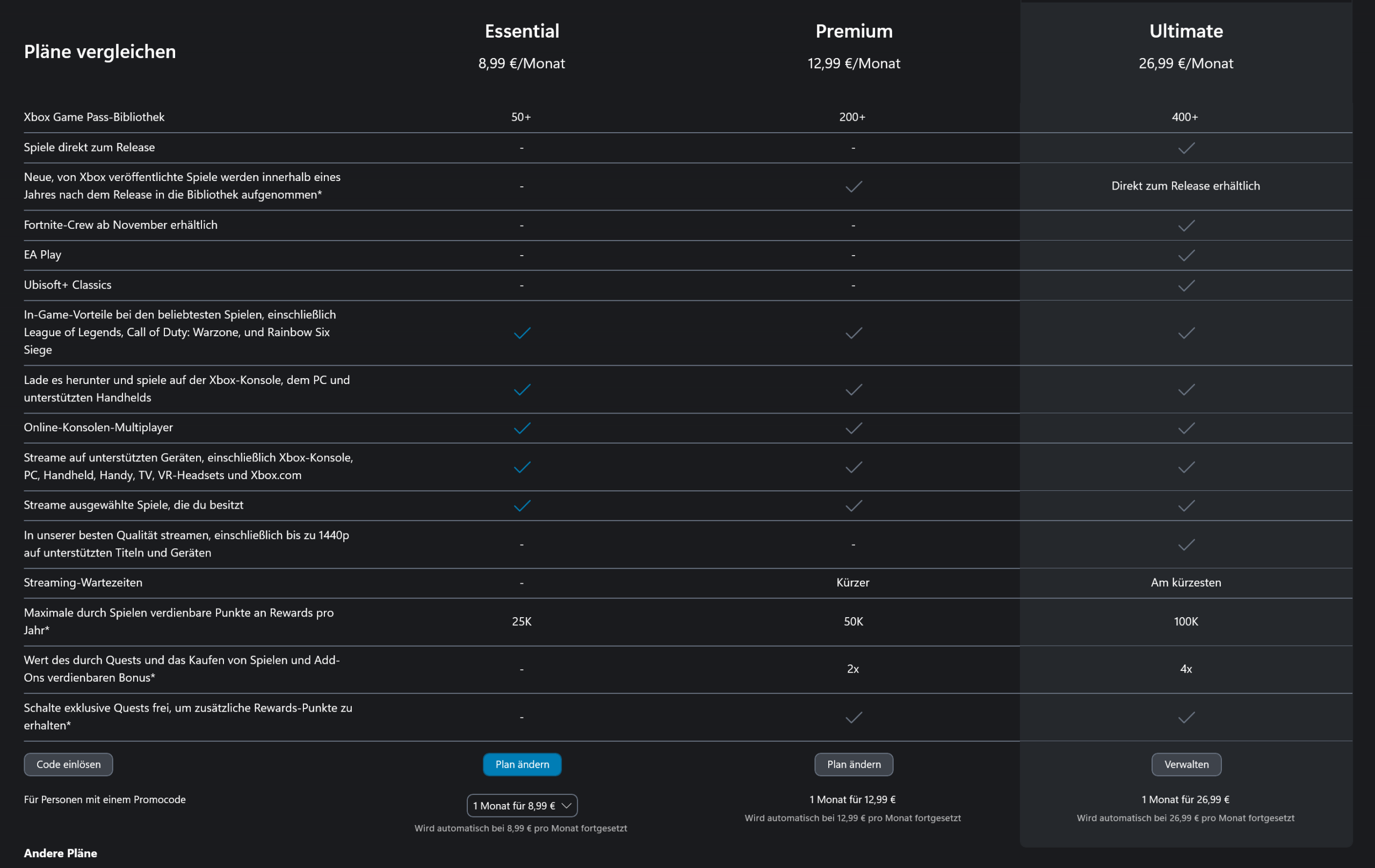
This means that the Game Pass Ultimate will now cost over €300 per year – a price that makes many gamers think twice. It’s no surprise that the Microsoft cancellation page temporarily crashed due to too many players wanting to cancel their subscriptions.
Contents of the Game Pass – Curse or Blessing?
One must give Microsoft credit: The Game Pass offers a lot of content.
- Hundreds of games from all genres
- Exclusive titles like Forza Horizon, Halo, Starfield
- Acquisition of major brands like Call of Duty, which are now also available to play via subscription
- Day-One-Releases new title
For me personally, the Game Pass was worth its weight in gold because I could finally catch up on the Call of Duty campaigns. Short, snappy single-player shooters that are a lot of fun – and for which I definitely wouldn’t have paid 70 € every time otherwise.
At the same time, I also notice: I only play a fraction of the available games. I often try many briefly and then stop. The sheer number of titles paradoxically makes individual games feel less “valuable” to me, as they are simply “part of the subscription.”
Threat to the Xbox Division: Risk for the Entire Ecosystem
The Game Pass is no longer just an add-on service – it is the cornerstone of the Xbox ecosystem. Microsoft connects two pillars here:
- Game Pass as a Link: It makes Xbox appealing because you get access to hundreds of games and Day-One releases right away.
- Xbox hardware as a foundation: No Xbox (or PC), no Game Pass – the services support console sales.
The latest figures make this clear:
- The Game Pass now generates almost 5 billion US dollars per year and is Microsoft’s most important growth factor in gaming.
- The total gaming revenue of Microsoft is around $23.5 billion annually, with hardware sales recently dropping by more than 20%.
- At the same time, revenue from Content & Services (including Game Pass) increased by 13% year-over-year.
This shows: Without Game Pass, there is no sustainable growth. If the subscription becomes unattractive for many due to the price increase, it could not only slow down subscription numbers but also directly weaken console sales.
Microsoft is therefore risking its painstakingly built “Xbox + Game Pass” ecosystem: what was once a must-have could become a nice-to-have – and that is dangerous for the future of Xbox.
My Personal Conclusion
The Game Pass has been an absolute reason to buy the Xbox for me for many years. It offered an incredibly affordable way to try out new games right at launch, catch up on classics, and simply have a massive game portfolio at my disposal.
However, with the new prices, a pain threshold has been crossed for me. Over €300 a year for a gaming subscription – in addition to Netflix, Spotify, Disney+, and countless other subscriptions – is simply a significant amount. Especially in times when many budgets are tightening, it’s hard to justify.
In my opinion, Microsoft is risking quite a bit here:
For me personally, it holds true: Under €20 a month, I would have accepted that. But at nearly €30 per month, I will seriously consider whether I still need the Game Pass – or if I would prefer to buy individual games that I really want to play.
Switching to a smaller tier is not an option for me – because the little perks like EA Play and the Day One releases that originally defined the Game Pass would be lost, and I would have to check every time whether the game I want to play is even included. This makes the Game Pass no longer what it should be for me.
What do you think?
Will you stick with Game Pass despite the price increase, or will you pull the plug?
Streaming and Subscription Fatigue: When is it Enough?
In the past, people almost felt excited when they signed up for a new subscription. Netflix, Disney+, Apple TV+, Game Pass – it felt like a new freedom: unlimited access to content that used to be expensive to pay for individually. At first, it wasn’t exactly cheap, but it was new, exciting, and seemed fair.
Today, the picture has completely changed. Prices have risen, providers are splitting their models into more and more tiers, sharing is being restricted, and the most expensive levels are hardly affordable for many. On top of that, there is advertising even in the paid model – a development that simply seems absurd.
I personally have drawn my conclusions: I now subscribe to services only monthly and selectively. When I want to watch or play something, I book the subscription for one month – and then cancel it again. Because the risk of losing track is high, and in the end, you end up paying more than you actually use.
This also applies to the Game Pass: Yes, it was clear that Microsoft couldn’t offer the service at rock-bottom prices forever. The tricks back then to stock up cheaply for years were a win-win situation for players, which Microsoft silently tolerated at the time. But now we are at a tipping point:
- All providers want maximum profit.
- Prices are rising somewhat aggressively.
- And for the same amount that was paid in the past, today you only get the stripped-down basic version.
Of course, there will always be target audiences for whom this fits – young players with fewer ongoing costs may still celebrate the Game Pass. However, for me personally, the limit has been reached: I calculate how many subscriptions I have, how little time I really have left, and then I ask myself: Why?
In the end, I prefer to abstain, specifically buy a few games on sale, or treat myself to a blockbuster at launch – on PlayStation or Steam. Because what I don’t want is to receive the worst for premium prices. And unfortunately, that’s exactly the direction in which streaming and gaming subscriptions are currently drifting.
🤖 Transparenz: Meine Beiträge schreibe ich selbst, mit meinen eigenen Erfahrungen und meiner Meinung. Für Formulierungen und Korrekturen nutze ich KI als Werkzeug – jeder Text wird von mir geprüft und verantwortet. Gelegentlich verwende ich KI-generierte Bilder; diese kennzeichne ich direkt am Bild. Mehr zur KI-Nutzung · Als Amazon-Partner verdiene ich an qualifizierten Verkäufen.
🤖 Transparency: I write my articles myself, based on my own experience and opinion. I use AI as a tool for wording and corrections – every text is reviewed and approved by me. Occasionally I use AI-generated images; these are labeled directly on the image. More about my use of AI · As an Amazon Associate I earn from qualifying purchases.


