

PlayStation 5 Pro in a long-term test: Was the purchase really worth the money?
When Sony announced the PlayStation 5 Pro at the end of 2024, I was fundamentally against it. Over 700 euros for a mid-gen upgrade – no disc drive included, no stand. I had the regular PS5, had installed a 2TB SSD, everything was running great. And then friends came along and raved after a round of Battlefield 1: “The Pro is so much better, get it!”
My first thought was clear: For this price, there are more important things in life. I read many reviews, watched YouTube videos – and kept coming to the same conclusion: Nice-to-have, not a must-have. Then Christmas came, a cashback offer appeared, the PS5 Pro was suddenly about 100 euros cheaper – and somewhere between reason and gadget enthusiasm, I took the plunge. I also got an external drive because I have most of my games on disc.
And now, after weeks in everyday life, I want to share my honest experiences – from genuine highlights to the points where Sony really falls short.
A noticeable upgrade – but no generational leap
The PlayStation 5 Pro is a significant upgrade over the standard PS5. The GPU has been substantially enhanced, delivering around 45% more rendering power according to Sony. Additionally, it features 28% faster memory and Sony’s own AI upscaling called PSSR (PlayStation Spectral Super Resolution) – comparable to Nvidia’s DLSS. The result: smoother frame rates, sharper images, and improved ray tracing.
In addition, it comes with 2 TB of internal SSD storage out of the box, faster Wi-Fi, and full backward compatibility with all PS5 games. The case is more compact than the original PS5 – and it’s also much easier to open, which is very convenient when installing the SSD.
The Surprising Killer Feature: Load Times and System Responsiveness
What surprised me the most is not the graphics – it’s the speed. Everything feels faster: menu transitions, loading times, the jump into the game. In Battlefield 5, for example, the loading times are noticeably shorter. It may sound like a minor detail, but it makes a huge difference in everyday life – especially when gaming time is already limited.
Honestly, I don’t quite understand why the Pro feels so much faster – the SSD chip itself shouldn’t have changed drastically. But it is the case. Everywhere you used to think with the old PS5, “ugh, waiting again” – now it just zips by. This aspect alone makes the upgrade worth it for me, especially if you can sell the old PS5 for a good price. Because if you want to game, you want to game – not wait.
Graphic: Better – but is it really necessary?
The eternal point of criticism in all YouTube reviews: Do you need it? Can you see the difference? Is it worth it? The honest answer: Yes, the difference is noticeable – but it’s not a paradigm shift. The image is sharper, the framerate smoother, and details appear crisper. This is especially noticeable in games with a PS5 Pro enhancement patch – like Battlefield or Gran Turismo 7.
I have had an 85-inch Samsung Neo QLED with 144 Hz since mid-last year – on a TV like this, a graphics upgrade is certainly much more noticeable than on an older 55-inch model. And yes: Everything just looks better on this setup.
I felt like I was actually playing better in the early rounds of Battlefield on the Pro – whether that was truly due to the higher frames per second or just my good conscience is hard to say. But the overall gaming experience definitely felt more premium.
Nevertheless, it holds true: Those who have the standard PS5 and don’t own a really good TV will hardly notice the difference. It remains a Nice-to-have – not a Must-have. One should honestly acknowledge this before making a purchase.
The Move from PS5 to PS5 Pro: Easier Than You Think
My biggest concern before the purchase was the data transfer – especially because of my upgraded 2TB SSD. I had read that games need to be reinstalled, that external SSDs cannot be transferred, and so on. The good news: The move went smoothly and was surprisingly fast.
The process works like this: Connect both consoles to the same network, then navigate on the PS5 Pro to Settings → System → System Software → Data Transfer → Continue. The Pro automatically detects the old console on the network, you select which data to transfer – games, save data, settings – and then everything runs automatically. Using a LAN cable, it took me about 20 minutes, very quick.
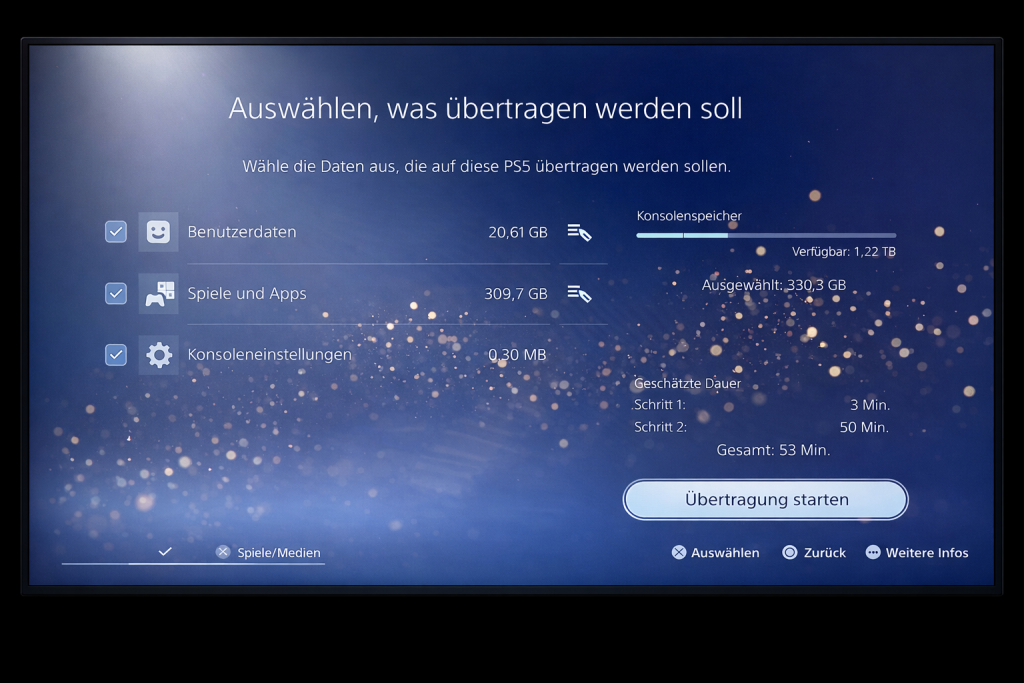
Important to know: Data on external SSDs or the second M.2 slot will not be transferred automatically. I was briefly worried that the whole process might go wrong. My solution was simple: removed the SSD from the old PS5, installed it in the new Pro – and all games were immediately there. No reinstallations, no drama.
The Pro’s case is also easier to open than that of the old PS5, making the SSD transfer even more convenient. I give full stars for setup and transfer – Sony really nailed it.
Gran Turismo 7, PSVR2 and My Racing Setup
I own the PlayStation VR2 and a small racing simulator setup: force-feedback steering wheel, racing seat, and a Buttkicker transducer for vibration feedback. Gran Turismo 7 in VR was already one of the most impressive gaming experiences I’ve ever had on the old PS5 – rain battles at the Nürburgring, a Porsche from the inside in the virtual cockpit, it’s simply magical.
Unfortunately, I haven’t had the chance to properly test the combination of PS5 Pro + PSVR2 + Gran Turismo 7 yet – that’s still on my list. What particularly excites me is the Abu Dhabi track, which was added to Gran Turismo 7 in December via an update. I actually drove this track once in a real Formula 3 race car – it’s a very special personal story, and I’m curious to see how it feels in VR on the Pro. Once I’ve tested it, I’ll provide an update to this post.
Motorfest + Govee Backlight = next level
In addition to Gran Turismo 7, I have also played Motorfest extensively on the PS5 Pro – a fantastic racing game that I enjoy even more in combination with my Govee Backlight system. The backlight reacts to the game colors, making the entire experience even more immersive. You can find more details in a separate post. The PS5 Pro also delivers noticeably more here – smoother frames, faster response times, sharper graphics in curves. Highly recommended.
The DualSense Edge: A Luxury Item with a Key Advantage
For Christmas, I also received the DualSense Edge Controller – the approximately 200 Euro pro gamepad from Sony. My honest verdict: I love it. And I’m a bit annoyed that I love it, because the price is hard to justify.
The killer feature is the triggers. The adaptive triggers of the Edge are stronger, more precise, and provide more feedback. In racing games like Motorfest or shooting in Battlefield, this makes a noticeable difference – this haptic feedback is, for me, the ultimate killer feature of the entire PlayStation platform.
In Gran Turismo, you can feel the triggers building resistance when braking, accelerating, and steering – it’s an experience that Xbox simply can’t offer. Because of this, I would seriously consider buying Forza Horizon 6 for PlayStation, just to experience it in another racing game.
What’s annoying: The battery drains noticeably faster than with the regular DualSense – especially during longer sessions, this can be quite frustrating. The casing doesn’t feel as comfortable in hand due to the differently shaped grips compared to the standard controller – it somehow feels a bit smaller, the horns feel different, which can become slightly uncomfortable over time. And all the customization features – interchangeable sticks, additional back buttons – I don’t use at all. So I’m paying for them without needing them.
My conclusion about the Edge: At 120–130 euros, it would be a clear buy. At 200 euros, it’s a tough purchase. However, once you have it, you’ll only reach for it – solely because of the triggers.
PlayStation vs. Xbox: Why Sony is Currently in the Lead
I’m not a console fanboy; I look at it objectively. But right now, for me, PlayStation is simply the stronger platform – and for a specific reason: the adaptive triggers. Xbox doesn’t have this feature, and I notice with every game launch what I would be missing there.
On top of that: Xbox is currently struggling, losing the favor of gamers. PlayStation, on the other hand, has PSVR2, Gran Turismo 7, Battlefield on the Pro, adaptive triggers, and now the performance of the PS5 Pro – for me, that is simply the place to be right now.
I spend a lot of time on the PC – and I’m glad when I can step away from it. On the couch, controller in hand, adaptive triggers, 85 inches, 144 Hz: That’s my gaming bliss. And the PS5 Pro is currently the best console I can imagine for that.
Weaknesses That Cannot Be Overlooked
As much as I love the Pro, Sony’s pricing policy deserves significant criticism. With a base price of €799.99, everything should ideally be included. However, it is not:
In Comparison: PS5 vs. PS5 Pro – Is the Upgrade Worth It?
The question everyone is asking: Is it worth upgrading from the standard PS5 to the Pro? The answer depends on several factors. If you game infrequently, don’t have a good TV, or can’t sell your old PS5 for a decent price, it might not be worth it. However, for those who play regularly, own a good 4K TV, and have the opportunity to sell the old console at a reasonable price – I clearly recommend the upgrade.
My advice in hindsight: don’t wait as long as I did. I should have bought the Pro earlier – if only for the time saved waiting on loading screens.
Feature Comparison
|
PS5 (2020) |
PS5 Pro (2024) |
|
|---|---|---|
|
GPU Performance |
Standard |
~45% more rendering performance |
|
Internal Storage |
825 GB SSD |
2 TB SSD (28% faster) |
|
Upscaling |
None |
PSSR (AI-based, like DLSS) |
|
Ray Tracing |
Standard |
2–3× faster (Advanced Ray Tracing) |
|
Disc drive |
Integrated (Disc Edition) |
Separate (approx. €120) |
|
Base stand |
In this context |
Separate (approx. €30) |
|
PSVR2 Compatibility |
Yes |
Yes (with potentially better performance) |
|
Adaptive Trigger |
Yes (DualSense) |
Yes (DualSense) |
|
Price (RRP) |
from €449 (Digital) / €549 (Disc) |
€799.99 (without drive & stand) |
Summary of Differences:
The choice depends on whether one is willing to dig significantly deeper into their pockets for noticeably more performance and a smoother system experience – or if one is completely satisfied with the tried-and-true standard PS5.
Shopping Links
On this page, you will occasionally find links to products on Amazon. If you make a purchase through one of these links, I receive a small commission – the price remains unchanged for you.
By making your purchase, you support my blog and help me continue creating exciting content and reviews for you. Thank you for your support!
Sony PlayStation 5 Pro
No disc drive. External drive sold separately.
PS5 Disc Drive (External)
Compatible with PS5 Pro – for everyone who uses physical games.
DualSense Edge Controller
Premium controller with stronger adaptive triggers. Expensive, but an experience.
